Palau to host Pacific leaders; about 2,000 people attend 55th Pacific Island Forum
BY OYAOL NGIRAIRIKL
Journal Staff
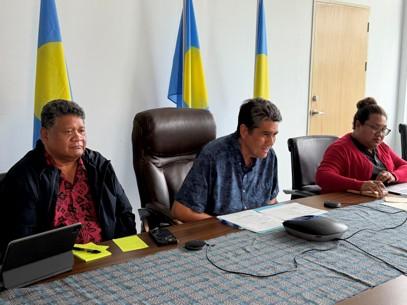
President Surangel S. Whipps Jr. leads a virtual meeting during a Troika meeting ahead of the 55th Pacific Islands Forum Leaders Meeting. With him are Minister of State Gustav Aitaro and Chief of Staff Landisang Kotaro. Photo courtesy Office of the President of Palau
KOROR, Palau — Palau is expecting to welcome about 2,000 people, including Pacific leaders and senior officials from Aug. 30 to Sept. 4 for the 55th Pacific Islands Forum Leaders Meeting, the region’s top annual gathering of heads of state and government.
The meeting is expected to focus on climate resilience, economic development, ocean stewardship, energy security and the future of the Blue Pacific.
Palau’s Congress, the Olbiil Era Kelulau, appropriated $390,000 to support the forum, but partners from across the Pacific are assisting in various ways.
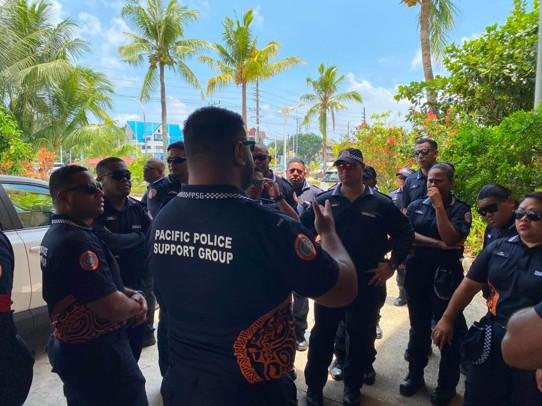
With so many heads of state and leaders gathering in Palau, security preparations are already underway. Police officers from across the Pacific have arrived to support the country’s Bureau of Public Safety with security operations for the Leaders Meeting, deployed through the Pacific Police Support Group — a multinational police response capability trained to rapidly deploy to Pacific island countries for major planned events or unplanned crises such as natural disasters, according to the Pacific Islands Forum Secretariat.
Forum Troika leaders toured the group’s Pinkenba Hub in Brisbane, Australia, in January and met with Pacific Police Support Group members ahead of the deployment.
Troika leaders are the chair of the Pacific Islands Forum (the president of Palau), the prime minister of the Solomon Islands, and the prime minister of Tonga.
The Forum brings together the 18 members of the Pacific Islands Forum, along with associate members, dialogue partners and regional organizations, to set policy direction for the year ahead. This year’s gathering, to be held in Koror, will run under the theme “B.E.L.A.U. — Building Economies: Life. Action. Unity.”
The event is a chance to engage Pacific partners on issues that hit close to home economically — energy affordability, infrastructure, transportation, digital connectivity, tourism, food security, climate adaptation and the management of ocean resources. Leadership from the Federated States of Micronesia, the Marshall Islands, Guam and the Northern Mariana Island are expected in Koror, along with leaders and representatives from Forum member countries, dialogue partners and regional organizations.
Palau’s hosting also carries some regional history behind it. This is the first time in more than eight years that the wider Pacific Islands Forum has returned to Micronesia — it was most recently hosted in Nauru, which is considered a part of Micronesia. The event also comes just days after the 28th Micronesian Islands Forum wrapped up in Pohnpei in the FSM — a meeting President Surangel S. Whipps Jr. framed explicitly as preparation for Palau.
Speaking in Pohnpei, Whipps urged fellow Micronesian leaders to arrive in Koror “aligned in priorities,” not just in attendance. He pointed back to a tense stretch five years ago, when Micronesia’s voice was sidelined in the Forum’s leadership and the subregion was prepared to walk away from the bloc entirely rather than accept being treated as a lesser partner.
That standoff led to the Suva Agreement, and Whipps noted some of what came out of it: Nauru’s Baron Waqa, a Micronesian, now serves as the Forum’s secretary general; a subregional office has opened in Kiribati; and the Office of the Pacific Ocean Commissioner in Palau is headed by a Micronesian. He told leaders the lesson to carry into Palau is simple — when Micronesia speaks with one voice, the region listens — and pushed for the Micronesian Islands Forum’s committee work on oceans, transportation, energy and climate resilience to feed directly into a coordinated position, rather than leaving Micronesia’s priorities to be shaped for it once the larger Forum convenes.
The FSM was represented in Pohnpei by Vice President Aren B. Palik, who addressed regional leaders, dignitaries, development partners and youth representatives on the Forum’s opening day, Aug. 19.
Palau pif 2 - Members of the Pacific Police Support Group are in Palau preparing for the 55th Pacific Islands Forum Leaders Meeting. Photo courtesy Pacific Islands Forum Secretariat
Palik laid out priorities for the FSM and the wider Micronesian region spanning tourism and transportation connectivity, trade and investment, ocean conservation, energy security, climate change, health, gender equality and skills development. On tourism, he pushed for air connectivity beyond the traditional east-west corridor, arguing that stronger north-south links could open new economic and tourism opportunities for the subregion. “If we truly want to unlock the economic potential of our islands, we must think beyond the traditional corridors,” Palik said. He closed by urging participants to approach the Forum’s discussions with openness and a commitment to consensus.
Palau is hosting the Forum leaders meeting for the first time since 2014. As the incoming Forum chairman, Whipps has said he wants the gathering to deliver practical results rather than another round of regional commitments without follow-through.
“We do not want another meeting where there is only talk,” he said. “We want action, implementation, and deals that benefit our people.”
Whipps has also spent recent months courting leaders, development partners, investors and nongovernmental organizations from outside the region to take part in dialogue on Pacific priorities — ocean protection, weaning the region off fossil fuels, and financing a more resilient regional economy.
“I’ve tried to invite the highest level of representation from governments and nongovernment organizations,” he said. “We want the highest level of representation coming to Palau. It’s important that our partners understand our challenges and how we can work together to build a resilient and prosperous Pacific.”
That outreach took him to Europe in June, with stops in Germany, the United Kingdom and France for meetings with government officials, development partners and potential investors — including the Berlin Climate Mobility Forum 2026, London Climate Action Week, and meetings of the Organization for Economic Cooperation and Development’s Development Assistance Committee in Paris. The trip was meant to build support for Pacific priorities ahead of both the Forum leaders meeting and the 31st United Nations Climate Change Conference, or COP31.
“This is a very important time because it’s the beginning of events leading up to COP31,” Whipps said during the trip. “For us, in talking to European leaders, what’s important is energy transition, which is critical to staying below 1.5 degrees; investing in resilience through the Pacific Resilience Facility; and investing in oceans, ocean protection, and ocean development through Unlocking Blue Pacific Prosperity.”
Unlocking Blue Pacific Prosperity is a Pacific-led ocean-finance initiative co-launched by Palau to mobilize large-scale investment in ocean management, conservation and sustainable ocean-based development. Whipps said Palau is also pushing for greater private-sector investment from Europe into Pacific economies.
The B.E.L.A.U. theme for the Forum borrows Palau’s traditional name, Belau, and is built around three ideas. “Life” puts people, families and future generations at the center of development — investment in education, health care, housing, food security and social protection, alongside Pacific cultures, languages and community values. For island economies like those across Micronesia, that’s tied directly to resilience: high import costs, dependence on fuel shipments, limited land and natural resources, transportation constraints and growing exposure to climate-related disruptions are everyday realities, not abstractions.
Those pressures aren’t hypothetical for two of Palau’s closest neighbors, both of which fall under the Journal’s regular coverage. The Marshall Islands declared a 90-day state of economic emergency in March after global fuel prices spiked amid the conflict in the Middle East and disruptions near the Strait of Hormuz. The country generates about 90% of its electricity from imported diesel, and Majuro absorbed one of the steepest rate increases in Marshalls Energy Co. history this year — an 11-cent-per-kilowatt-hour hike delivered in two steps in May. Taxi fares in Majuro jumped as much as 50%, and the World Bank has stepped in with additional budget support to help the government cushion households and keep essential services running.
The Federated States of Micronesia faces a different version of the same problem. FSM has some of the lowest electricity access rates in the Pacific, with roughly two-thirds of households in Chuuk State still without power, and residential electricity rates in parts of the country running above 48 cents per kilowatt hour — among the highest in the region. A $42 million World Bank-backed project is now underway to expand access and improve reliability across FSM’s four states, Chuuk, Kosrae, Pohnpei and Yap, while also growing the share of renewable energy in the national power mix.
“Action” is about turning regional commitments into implementation — climate and ocean action, resilient infrastructure, renewable energy, digital connectivity, workforce development and support for micro, small and medium-sized businesses. Whipps has named three priorities for Palau’s chairmanship: advancing a “100% Renewable Pacific,” unlocking Blue Pacific prosperity through responsible ocean management, and improving access to climate finance through Pacific-led mechanisms like the Pacific Resilience Facility. That agenda lands close to home for Guam and the NMI, where utility reliability, fuel costs, disaster preparedness and infrastructure modernization remain ongoing business and public-policy concerns.
The meeting will also put a spotlight on ocean governance and the economic potential of the Blue Pacific. Palau has pushed an approach that treats environmental protection and economic development as complementary, not competing.
“We do not see prosperity and conservation as competing goals,” Whipps said. “In Palau, we believe in balancing protection with production.”
That philosophy traces back to Palau’s traditional bul resource-management system, where communities restrict harvesting of certain resources to let them recover — an example, Palau has argued, of how traditional knowledge can shape modern fisheries, marine conservation and sustainable-development policy.
“Unity,” the third piece of the B.E.L.A.U. framework, calls for closer cooperation among governments, traditional leaders, businesses, civil society, women, youth and development partners, built around the idea that Pacific islands and territories share common challenges — climate change, biodiversity loss, debt pressures, inequality and regional security concerns.
The Forum comes as Pacific governments work to hold a unified regional voice together amid heightened outside interest in the region. Palau has said it intends to use its chairmanship to keep Pacific countries and territories at the center of decisions on regional security, natural resources, development and the future of the ocean.
For businesses in Guam, the NMI and neighboring Micronesian economies, the week in Koror offers a read on regional policy discussions that could shape future investment, tourism cooperation, trade relationships, infrastructure development, energy transition, digital expansion and ocean-based industries.
Under the B.E.L.A.U. theme, Palau is looking for commitments that strengthen economic opportunity, protect the Pacific environment, and deliver visible benefits to communities across the region. mbj
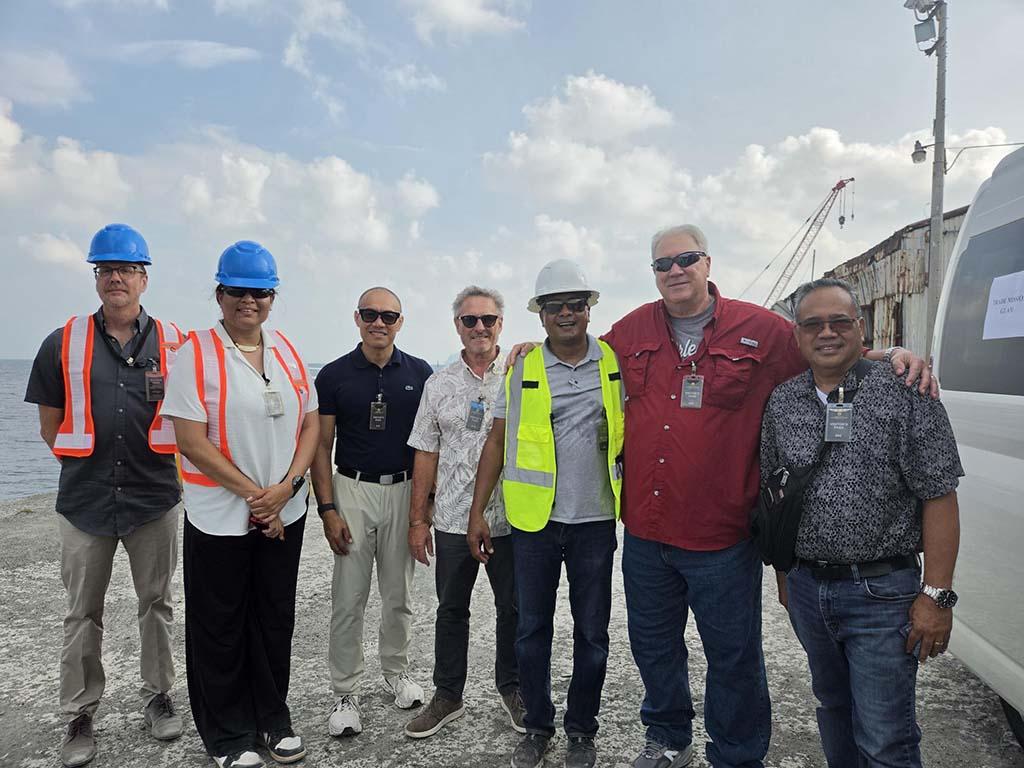
KOROR and MELEKEOK, Palau — A select group of businesses participated in the Guam Business Magazine Trade Mission to Palau the week of Sept. 28, which was also supported by the Journal.
The United States and Australia announced on Sept. 2 at the Pacific Island Forum that each country will donate funding for the Pacific Islands, for a total of $580 million.
Qantas will double its direct service between Brisbane and Koror to two return flights a week during the peak season, after signing a new agreement to continue operating the Palau Paradise Express.